

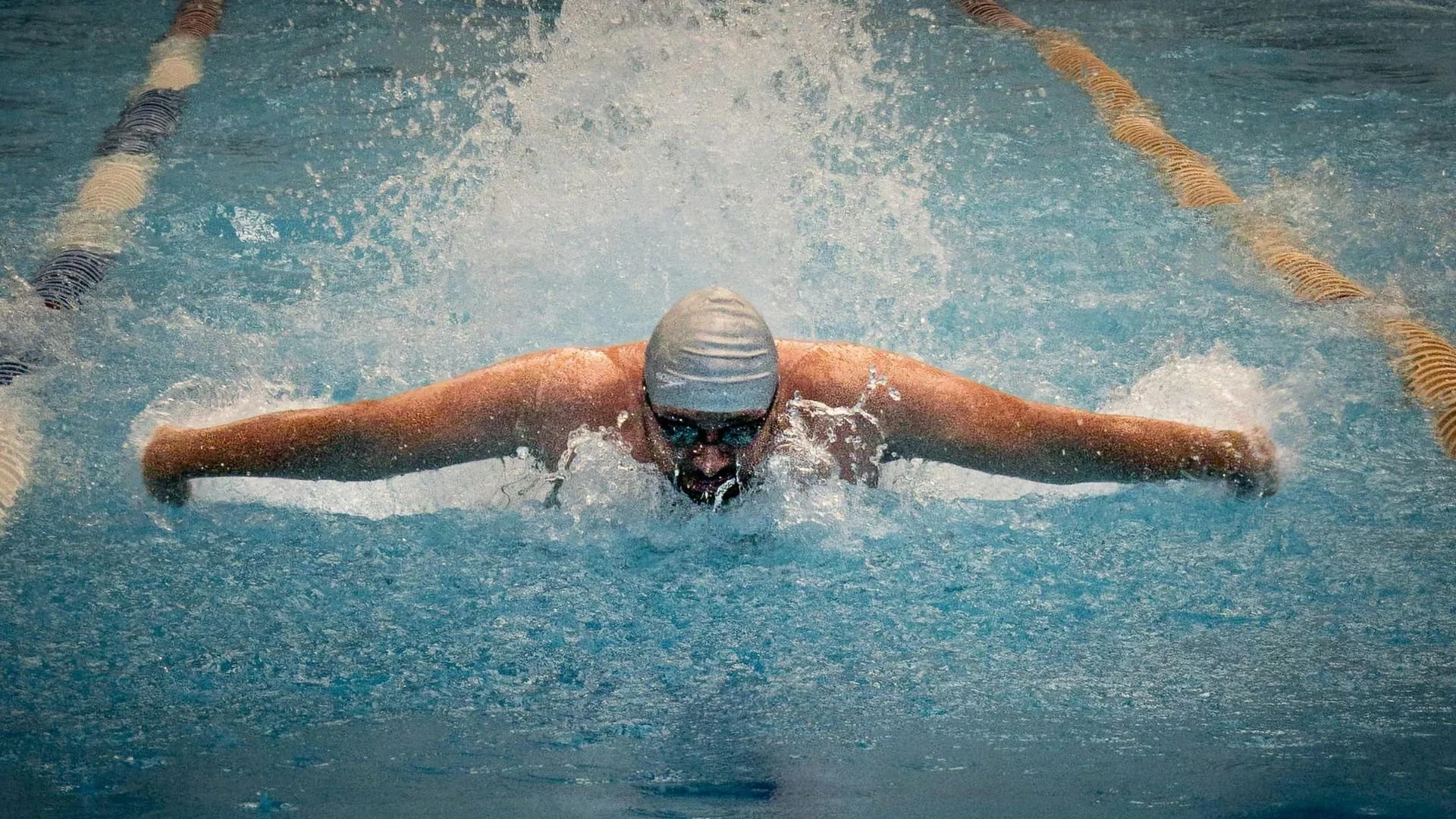
The first few minutes back in Port Phillip can feel wonderfully familiar. Then you look up to find your swim partner, a patch of chop interrupts your breathing, and the shoulder that felt comfortable in the pool starts to complain. The distance on your watch tells only part of the story.
For Bayside swimmers returning after a quieter winter, preparation means rebuilding a swimming routine as well as getting used to open water again. An event can give that preparation a purpose. It should not become a reason to ignore a shoulder that hurts earlier each time you swim.
Start with the swimming you have actually done
Your longest swim last summer is a memory, not a measure of this week’s readiness. Look at your recent sessions: how often you swam, how hard you worked and whether you finished comfortably. A few relaxed pool visits are a different starting point from regular training, even if both swimmers have entered the same event.
Swimming shoulder problems rarely reduce to one simple cause. No single stroke fault or training number explains everyone's pain, and what holds for competitive swimmers doesn't always apply to recreational adults. It does not establish that one stroke fault or training number explains everyone’s pain. Findings from competitive swimmers also need care when applied to recreational adults.
Make your first sessions useful opportunities to observe, rather than attempts to prove that your old fitness is still there. Notice how the shoulder feels during the swim, later that day and the following morning. If it is already sore, ask about an appropriate starting point before adding more work.
Change the demand without changing everything
Distance is only one part of a session. A short swim with hard efforts or unfamiliar equipment can feel very different from an easy swim of the same length. In your training notes, record the kind of swimming you did as well as the total distance. “Easy pool swim, comfortable throughout” tells you more than a number alone.
For a manageable comparison, keep some things familiar when trying something new. If you are extending a swim, it may be sensible to leave the faster efforts for another session. It's simply a way to notice what your shoulder tolerates.
A fixed weekly percentage increase cannot guarantee a safe return. A suitable progression depends on your recent training, symptoms and circumstances. A clinician or coach can help you work out which part of the session to adjust, rather than treating every setback as a reason either to stop all activity or push through unchanged.
Fatigue is information worth listening to
“Swimmer’s shoulder” describes a problem, not a diagnosis you can make from the location of an ache. Different shoulder conditions can affect swimmers. Repeated swimming, fatigue and technique can all play a part, so it usually makes more sense to adjust the training that aggravates your shoulder than to swim through the pain.
Pay attention to the point when a comfortable stroke becomes a struggle. Perhaps your pull starts to feel uneven, or you keep shortening the stroke to avoid a sore movement. Those observations are useful to share; they do not tell you which tissue is responsible.
If pain changes the way you swim, finish the session rather than chasing the planned distance. A coach watching a few lengths while you are fresh, and again when you begin to tire, may help identify a practical technique question. Persistent pain still needs clinical assessment; a coaching cue cannot settle a diagnosis.
Give sighting and chop their own practice time
Pool swimming gives you a black line, lane ropes and regular walls. In the bay, you need to check your direction and surroundings while keeping a workable breathing rhythm. That is a skill to rehearse, rather than an inconvenience to endure during a longer swim.
Lifting your head can let your legs drop and throw off your body position, so practise sighting in the pool first and adapt it to the conditions. It recommends practising sighting in the pool and adapting it to conditions. The point is to learn a brief, useful look ahead, not to keep your head lifted throughout the swim.
Ask a coach to help you find a comfortable rhythm, especially if every look forward leaves you struggling to breathe or regain your stroke. Do not assume there is one sighting frequency that suits calm water, chop and a crowded event equally well.
Make an early open-water outing about familiarity rather than pace. Agree with your partner where you will finish and how you will signal if you need to stop. If conditions make you feel out of control, choose a supervised pool session instead of turning the day into a test of determination.
Conditioning can help without becoming a magic routine
Shoulder strength and endurance deserve a place in the conversation, but a generic band routine is not a guarantee against injury. Targeted exercise can improve shoulder strength and endurance, but stronger shoulders don't guarantee that every swimmer will stay pain-free.
If you're assessed as having rotator cuff tendinopathy, an active rehabilitation programme with resistance or movement-control exercises may help. That plan should be tailored to you, so it's worth getting assessed rather than treating every swimming ache as a tendon problem.
Bring your swimming goals into an assessment. Ask which capacities need work, how exercises fit around swimming and what response should prompt a change. The useful outcome is a plan you understand and can follow, with a way to review progress. More exercises are not automatically a better plan.
Recurring pain should change the next decision
An ache that appears only near the end of one unusually demanding swim is a different story from pain that starts earlier each session or follows you into ordinary activities. Keep a short record of when it begins, which movements bother it and whether it affects sleep. That gives an assessment a concrete starting point.
Arrange a review if symptoms keep returning, persist or make everyday movement difficult. Avoid repeatedly testing the painful stroke to see whether the problem has disappeared. Discuss what activity remains appropriate while the shoulder is assessed, rather than guessing from an online exercise list.
Seek immediate medical attention after an injury if your shoulder looks deformed, the pain is intense or there is sudden swelling. Loss of feeling or inability to move the arm also needs urgent medical attention. A routine training discussion should not delay care for those symptoms.
Prepare for the event and the bay you will meet
In the weeks before an event, practise the things you would rather not discover on the start line: whether your goggles stay clear, how you sight and how you communicate with a swim partner. Keep familiar sessions in the mix. A late burst of catch-up training or several new challenges at once can leave you with less useful information about what your shoulder handles.
Check Beachsafe for beach and patrol information, then reassess when you arrive.Check the conditions and swim between the red and yellow flags at patrolled beaches.
Swim with a friend, stay within your ability and follow event officials’ safety instructions at organised swims. An event entry does not make unsuitable conditions safe.
Port Phillip’s water quality is another reason a sensible plan may change. Avoid swimming for 48 hours after rain, and stay away from stormwater drains. Check current forecasts and alerts, and look for signs of pollution at the beach rather than relying on yesterday’s report.
Getting ready is about arriving with options: a swimming routine you have built from recent experience, practised open-water skills and a clear decision about any recurring pain. Some days the most useful preparation happens in the pool or in an assessment room. The bay will still be there when the conditions and your preparation line up.